Definition
PoE (Power over Ethernet) refers to a technology that transmits power through network cables. It uses the existing Ethernet to transmit data and power IP terminal devices (such as IP phones, APs, IP cameras, etc.) through network cables at the same time.
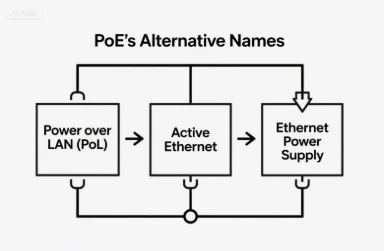
PoE is also known as a power supply system based on a local area network (Power over LAN, referred to as PoL) or active Ethernet (Active Ethernet), and is sometimes referred to as Ethernet power supply.
In order to standardize and promote the development of PoE power supply technology and solve the compatibility problem between power supply and powered devices of different manufacturers, the IEEE Standards Committee has successively issued three PoE standards: IEEE 802.3af standard, IEEE 802.3at standard, and IEEE 802.3bt standard.
System composition
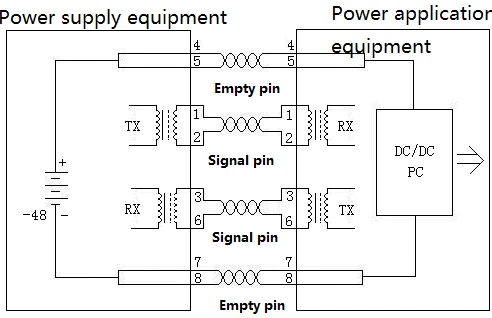
A complete POE system consists of two parts: the power sourcing equipment (PSE) and the powered device (PD). The PSE device is a device that provides power to Ethernet client devices and is also the manager of the entire POE Ethernet power supply process. The PD device is the PSE load that receives power, that is, the client device of the POE system, such as IP phones, network security cameras, APs, PDAs or mobile phone chargers and many other Ethernet devices (in fact, any device with a power of no more than 13W can obtain the corresponding power from the RJ45 socket). The two establish information about the connection status, device type, power consumption level, etc. of the powered device PD based on the IEEE 802.3af standard, and based on this, the PSE supplies power to the PD through Ethernet.
Power supply working process
When a POE power supply device is deployed in a network, the POE Ethernet power supply working process is as follows.
large ecterprise scale
1. Detection: At the beginning, the POE device outputs a small voltage at the port until it detects that the connection at the cable terminal is a powered device that supports the IEEE802.3af standard.
Wide Application Of Technology
2. PD device classification: After detecting the powered device PD, the POE device may classify the PD device and evaluate the power loss required by the PD device.
standardized production
3. Start power supply: During a configurable startup period (generally less than 15μs), the PSE device starts to supply power to the PD device from a low voltage until a 48V DC power supply is provided.
High-Quality Customized Services
4. Power supply: Provide a stable and reliable 48V DC power to the PD device to meet the power consumption of the PD device not exceeding 15.4W.
order management
5. Power off: If the PD device is disconnected from the network, the PSE will quickly (generally within 300-400ms) stop supplying power to the PD device and repeat the detection process to detect whether the terminal of the cable is connected to the PD device.
Advantages of PoE power supply
01
Easy installation: PoE is not limited to fixed power sockets and can be easily set up even in houses with old power infrastructure.
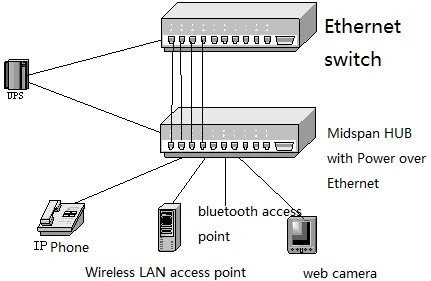
Simplify wiring, save space, and reduce installation and daily maintenance costs: PoE-powered devices only need one network cable to complete the functions of power supply and data transmission at the same time, so too many power adapters and cables can be connected. It will also help reduce the installation and daily operation costs of infrastructure, because it can use the existing network infrastructure, so it can be easily deployed, and users can also save costs by centrally managing power output through switches.
02
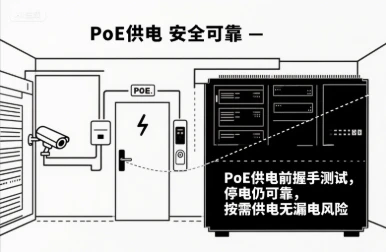
Safe and reliable: Active PoE will have a "handshake" test before the device is connected to confirm the compatibility between the two. In addition, PoE technology can also provide reliability in the face of emergencies such as power outages. For example, for modern computer rooms equipped with uninterruptible power supply systems, security cameras, access control systems and other equipment powered by PoE will not be deactivated due to power outages. Moreover, the POE power supply device will only power the devices that need power. Only when the devices that need power are connected will the Ethernet cable have voltage, thus eliminating the risk of leakage on the line.
Easy management: Like data transmission, POE can monitor and control the device by using the Simple Network Management Protocol (SNMP); users can automatically and safely mix existing devices and POE devices on the network, and these devices can coexist with existing Ethernet cables; in wireless LANs, POE can simplify RF testing tasks, and access points can be easily moved and accessed.
First-class professional team for you to recommend products more in line with your needs. Perfect after-sale services exempt your worries.
Our address
No.5F, Building 24, Longbi Industry City, Bantian Street, Longgang District, Shenzhen City, Guangdong Province, China
Phone Number
+86-755-28447130
+8613632535154
sales@bestview.cc