


Capacitive touch screen
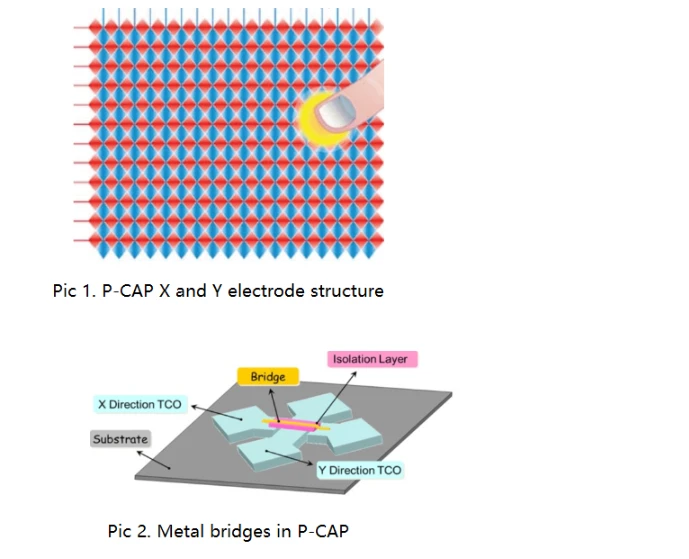
Projected capacitive touch panel (PCAP) was actually invented 10 years before the first resistive touch screen. But it didn't become popular until Apple first used it on the iPhone in 2007. Since then, PCAP has dominated the touch market, such as mobile phones, IT, automobiles, home appliances, industry, IoT, military, aviation, ATM, kiosks, Android mobile phones, etc.
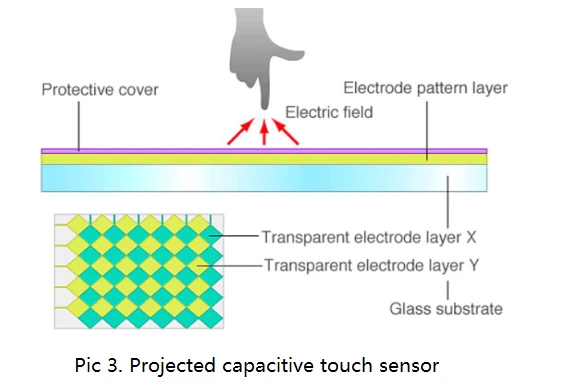
Projected capacitive touch screens contain X and Y electrodes with an insulating layer between them. The transparent electrode is usually made of ITO and metal bridges in a diamond pattern
The human body is conductive because it contains water. Projected capacitive technology uses the conductivity of the human body. When a bare finger touches the sensor with X and Y electrode patterns, capacitive coupling occurs between the human finger and the electrodes, causing the electrostatic capacitance between the X and Y electrodes to change. The touchscreen controller detects the electrostatic field change and position.
P-CAP has many advantages:
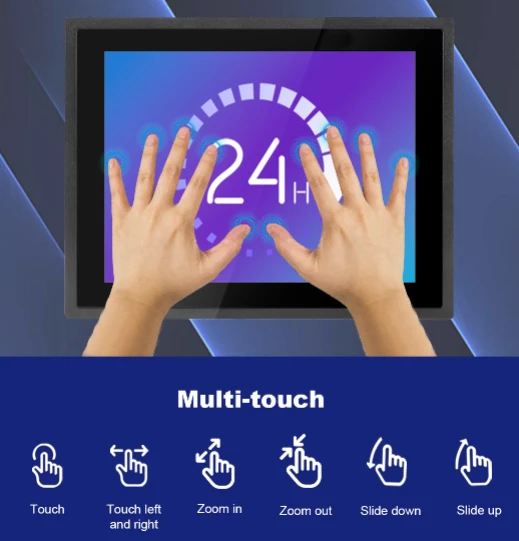
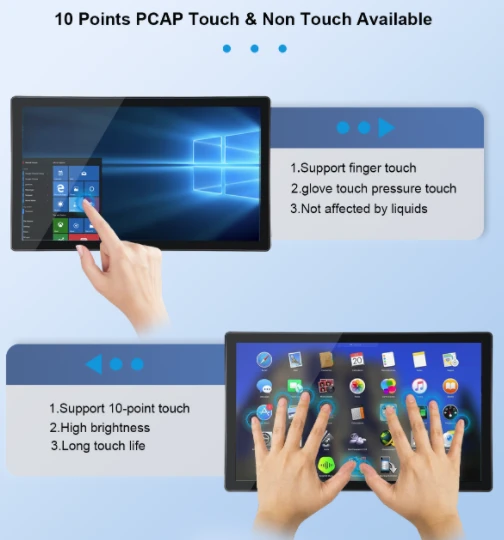
Projected capacitive supports multi-touch (Multi-touch), and therefore supports a wide range of gestures: pinch/spread, scroll, slide, drag, slide, hold/press, rotate, click, etc.
Excellent image clarity due to high transmittance.
Excellent sensitivity.
More scratch-resistant, as the surface can be made of tamper-resistant glass, such as Gorilla Glass or Dragon Glass, which can have a surface hardness of 9H. Only diamonds can scratch it.
Resistance to contaminants and liquids. Easier to remove dust, grease, moisture, etc.
With new developments, projected capacitive touch panels can support touch by gloved hands of different glove materials and touch by water or even salt water.
Resistive Touch Screens: An Introduction
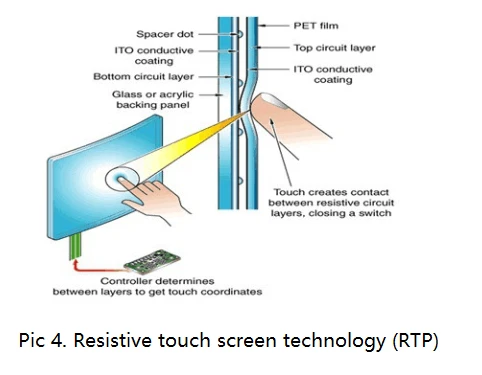
Before 2007, resistive technology was the most popular touch panel market. From its name, we know that the technology relies on resistance. Resistive touch screens are made of a glass substrate as the bottom layer and a film substrate (usually transparent polycarbonate or PET) as the top layer, each coated with a transparent conductive layer (ITO: Indium Tin Oxide) spaced by dots to form a small air gap. The two conductive material layers (ITO) face each other. When the user touches a part of the screen with a finger or stylus, the conductive ITO thin layer comes into contact. It changes the resistance. The RTP controller detects the change and calculates the touch position. The contact point is detected by this voltage change.
With the rapid development of projected capacitive, the market for resistive touch screen devices is shrinking rapidly, but it is still widely used in some industrial applications due to the following advantages.
Low cost and simple manufacturing process.
Low power consumption and easy to drive.
Any touch material can be easily activated as long as pressure (finger, stylus, glove, pen, etc.) is applied (not a key that causes surface scratches).
Rugged and durable in harsh climates and harsh environments, no false touches.
Resistive and capacitive touch screens
The following table shows a comparison of resistive and capacitive touch screens. The type of technology to use is determined by your application.
| Resistive touch Capacitive touch | ||
| Cost | Low | Relatively high, special design can be lower |
| Multi-touch | N | Y |
| touch gesture | Hard | Easy |
| Touch durability | 3H, easy to scratch | Up to 9 H, not easy to scratch |
| Energy consumption | reduce | Higher |
| Touch sensitivity | Low | High(adjustable) |
| Image clarity | Bad | Good |
| Touch material | any kind | Fingers. Can be designed to use other materials such as gloves, stylus, pencils, etc. |
| Contact with water and oil | No design changes | Requires special design |
| surface decoration | Hard | Easy |
| Different Figure | Hard | Easy |
| 2D surface | Hard | Easy |
| Size | Mid&Small | from small to large |
| under harsh environment | convenient | hard |
| Accidental touch | No | Requires careful calibration |
| Function Sensitive to EMI/RFI | Low | High, shielding must be designed |
First-class professional team for you to recommend products more in line with your needs. Perfect after-sale services exempt your worries.
Our address
No.5F, Building 24, Longbi Industry City, Bantian Street, Longgang District, Shenzhen City, Guangdong Province, China
Phone Number
+86-755-28447130
+8613632535154
sales@bestview.cc

touch panel pc,industrial panel pc windows 10,industrial monitor direct,rugged touch screen monitor,industrial touch screen computer,industrial screens,panel mount pc,elo industrial touch screen,advantech panel pc,all in one touch screen,all in one desktop computer touch screen,ip65 monitor,industrial all in one pc