


1.Overview of RS-232 Bus
The RS232 interface complies with the interface standard for serial data communication established by the Electronic Industries Alliance (EIA) of the United States. The full name of the original number is EIA-RS-232 (232, RS-232 for short). RS232 is widely used for computer serial interface peripheral connection. Connecting cables and mechanical, electrical characteristics, signal functions and transmission processes.
The data transmission rates specified by the RS-232-C standard are 50, 75, 100, 150, 300, 600, 1200, 2400, 4800, 9600, 19200 baud per second.


2. RS232 serial communication characteristics
RS-232 is one of the mainstream serial communication interfaces. Since the RS-232 interface standard appeared earlier, it is inevitable that there are some shortcomings, mainly the following points:
(1) The signal level value of the interface is high, which is easy to damage the chip of the interface circuit. The voltage of any signal line of the RS-232 interface is a negative logic relationship. That is: logic "1" is -3~-12V; logic "0": +3~+12V, and the noise tolerance is 2V. That is, the receiver is required to recognize signals higher than +3V as logic "0" and signals lower than -3V as logic "1". The TTL level is 5V for logic positive and 0 for logic negative. It is incompatible with the TTL level, so a level conversion circuit is required to connect with the TTL circuit.
(2) The transmission rate is low. In asynchronous transmission, the bit rate is 20Kbps;
(3) The interface uses a signal line and a signal return line to form a common ground transmission form. This common ground transmission is prone to common mode interference, so the anti-noise interference is weak.
(4) The transmission distance is limited. The maximum transmission distance standard value is 50 feet, and in fact it can only be used for about 15 meters.
二. RS485 serial communication
1. Overview of RS485 interface
When the communication distance is required to be from tens of meters to thousands of meters, RS485 serial bus is widely used. RS485 interface uses balanced transmission and differential reception, so it has the ability to suppress common mode interference. In addition, the bus transceiver has high sensitivity and can detect voltages as low as 200mV, so the transmission signal can be recovered thousands of meters away.
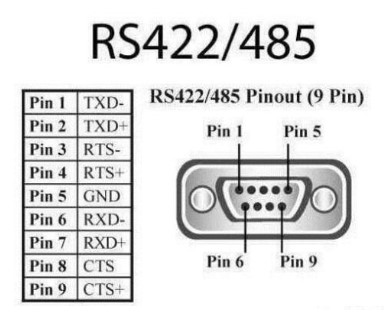
2. Characteristics of RS485 serial communication
RS485 serial communication is very convenient for multi-point interconnection, which can save many signal lines. RS485 serial communication can be used to form a distributed system through networking. In view of the shortcomings of RS-232-C, the new standard RS-485 has the following characteristics:
(1) Electrical characteristics of RS485: Logic "1" is represented by a voltage difference of +2V to +6V between the two lines, and logic "0" is represented by a voltage difference of -6V to -2V between the two lines. The interface signal level is lower than that of RS-232-C, so it is not easy to damage the interface circuit chip, and this level is compatible with the TTL level, which is convenient for connection with the TTL circuit.
(2) The RS485 interface uses a combination of a balanced driver and a differential receiver, which has strong anti-common mode interference capability, that is, good anti-noise performance.
(3) The maximum transmission distance of the RS485 interface is 4000 feet as standard, but it can actually reach 3000 meters.
RS232 interface is full-duplex, RS485 interface is half-duplex.
Different transmission modes. RS-232 communication adopts unbalanced transmission mode (single-ended transmission), RS-485 communication adopts balanced transmission (differential transmission mode).
Different communication distances. RS-232 transmission distance is shorter (maximum transmission distance standard value is 15 meters), RS-485 transmission distance is longer (maximum transmission distance is 1200 meters).
Difference in communication lines. RS-232 uses three-core twisted pair, three-core shielded wire, etc., RS-485 uses two-core twisted pair, two-core shielded wire, etc.
4. Modbus communication protocol
Modbus is a communication protocol, while RS-232 and RS-485 interfaces can only represent the physical medium layer and link layer of communication. Modbus protocol supports traditional RS-232, RS-485 and Ethernet devices. Many industrial equipment, including PLC, DCS, intelligent instruments, etc., are using Modbus protocol as the communication standard between them.

No.5F, Building 24, Longbi Industry City, Bantian Street, Longgang District, Shenzhen City, Guangdong Province, China
Our address
Jl Cempaka Wangi No 22 Jakarta - Indonesia
Phone Number
+86-755-28447130
+8613632535154
sales@bestview.cc

touch screen computer display,touch screen computer screens,panel pc,industrial monitor,industrial panel pc,industrial touch screen,industrial touchscreen monitor,all in one pc touch screen,touch screen computer,all in one touch screen computer,all in one computers touch screen,touch screen pc,all in one desktop touch screen