The Industrial Panel PC Memory Specifications
I. Primary Memory Types & Differences
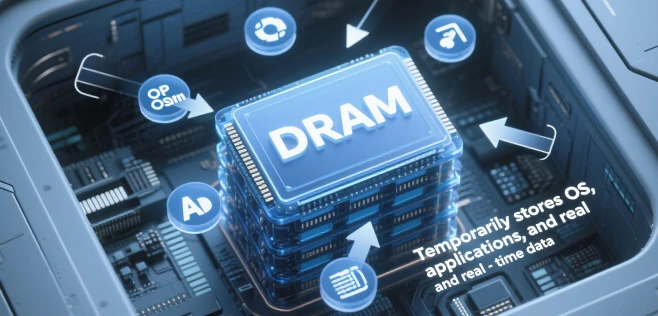
- Definition: Actual DRAM capacity installed (e.g., 4GB DDR4).
- Applications:
- Temporarily stores OS, applications, and real-time data.
- Directly impacts multitasking capability and responsiveness.
- Industrial Critical Features:
- Extended temperature support (-40℃~85℃).
- ECC Error Correction: Prevents system crashes (Critical!).
- Vibration resistance: Reinforced slots in industrial-grade modules.
- Example: 8GB DDR4 ECC SODIMM
2. Storage Memory (Flash/SSD)
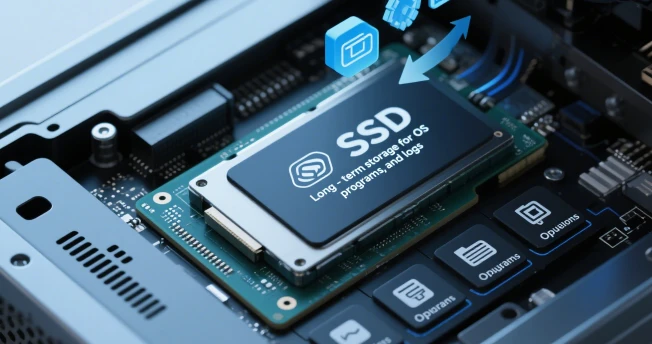
- Definition: Non-volatile storage (e.g., 128GB SSD).
- Applications:
- Long-term storage for OS, programs, and logs.
- Industrial-grade SLC/MLC NAND(not consumer TLC) for extended endurance.
- Industrial Features:
- Power-loss protection: Capacitors ensure data integrity.
- High endurance: Supports ≥1 Drive Writes Per Day (DWPD).
- Full-disk encryption (Optional): Secures production data.
- Example: 64GB SLC Industrial SSD
- Definition: Hard drive space emulating RAM (Windows Pagefile/Linux Swap).
- Industrial Limitations:
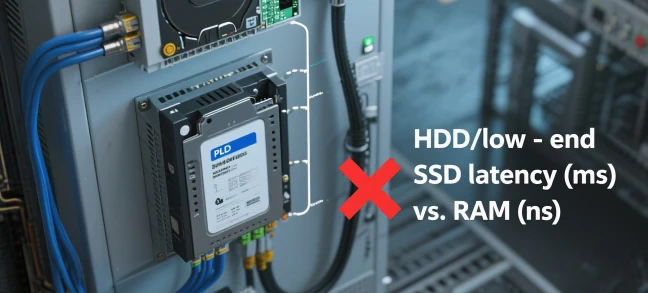
- Strongly discouraged! HDD/low-end SSD latency (ms) vs. RAM (ns).
- May disrupt real-time tasks (e.g., PLC control cycles).
- Alternative: Increase physical RAM or use RAM Disk.
4. Reserved Memory
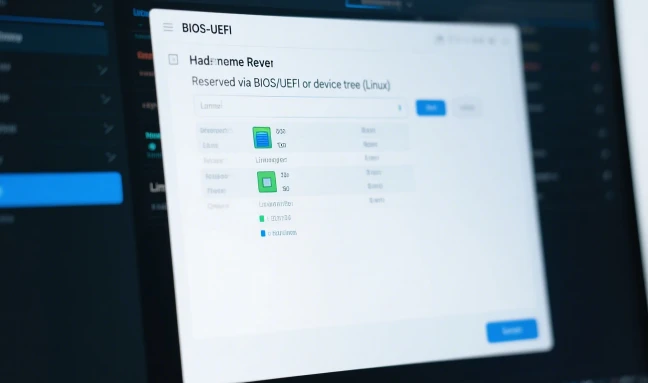
- Definition: Physical memory reserved for hardware (e.g., GPU VRAM, DMA buffers).
- Industrial Use Cases:
- Integrated GPU shared memory (e.g., Intel UHD Graphics: 512MB).
- DMA buffers for high-speed data acquisition cards.
- Configuration: Reserved via BIOS/UEFI or device tree (Linux).
II. Special Industrial Memory Requirements
1. Real-Time Memory
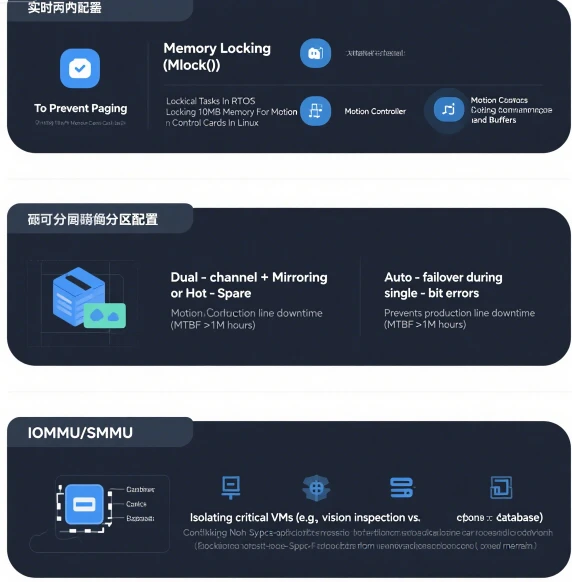
- Technology: Memory locking (mlock()) to prevent paging.
- Applications:
- Critical tasks in RTOS.
- Motion controller command buffers.
- Example: Locking 10MB memory for motion control cards in Linux.
2. Redundant Memory Configurations
- Technology: Dual-channel + Mirroring or Hot-Spare.
- Purpose:
- Auto-failover during single-bit errors.
- Prevents production line downtime (MTBF >1M hours).
3. Memory Partition Isolation
- Technology: Hardware isolation via IOMMU/SMMU.
- Applications:
- Isolating critical VMs (e.g., vision inspection vs. database).
- Blocking non-secure apps from accessing control core memory.
III. Selection Guidelines & Common Pitfalls
| Parameter | Consumer Pitfall | Industrial Best Practice |
| Capacity | Bigger is better | Calculate peak usage + 20% margin |
| Type | Standard DDR4 | Industrial Temp DDR4 + ECC |
| Storage Endurance | TBW (Total Bytes Written) | DWPD (Drive Writes Per Day) |
| Virtual Memory | Enabled by default | Disabled; use physical RAM |
| Maintenance | Neglected | Regular memory checks (EDAC logs) |
Key Conclusions:
Industrial panel PCs prioritize reliability over peak performance. Focus on:
01
1. Physical RAM + ECC
01
02
2. Industrial SSD endurance (DWPD)
02
03
3. Disabling virtual memory
03
04
4. Reserving locked memory for real-time tasks
04
05
5. Extended temp certification (-40℃~85℃)
05
Memory redundancy and ECC are more critical than capacity alone – failures may halt entire production lines. Implement mirrored memory + hot-swap for critical systems with real-time health monitoring.
First-class professional team for you to recommend products more in line with your needs. Perfect after-sale services exempt your worries.
Our address
No.5F, Building 24, Longbi Industry City, Bantian Street, Longgang District, Shenzhen City, Guangdong Province, China
Phone Number
+86-755-28447130
+8613632535154
sales@bestview.cc