


In the world of industrial automation, medical equipment, and rugged outdoor applications, the display is the critical window between the user and the machine. When specifying an industrial LCD monitor, two key interface technologies often come into play: MIPI and LVDS. Understanding their differences is crucial for selecting the right industrial touch monitor for your project.
At first glance, both MIPI DSI and LVDS are serial communication standards designed to transmit video data from a processor to a display. However, their architecture, performance, and ideal use cases differ significantly.
LVDS: The Robust Industrial Workhorse
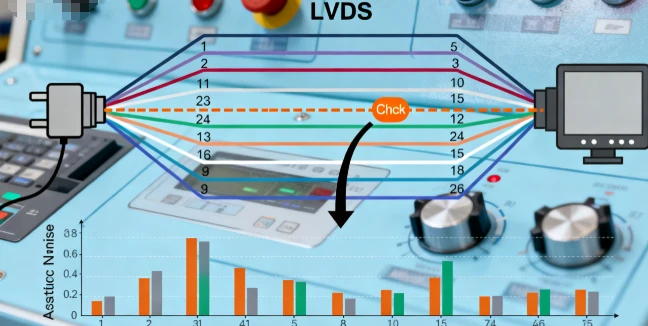
LVDS (Low-Voltage Differential Signaling) has been the longstanding backbone of industrial display connectivity. It's known for its simplicity, robustness, and noise immunity.
Architecture: Typically uses multiple data pairs and a separate clock signal. The number of pairs depends on the screen resolution.
Strengths:
Maturity & Stability: A well-established technology with proven reliability in harsh environments.
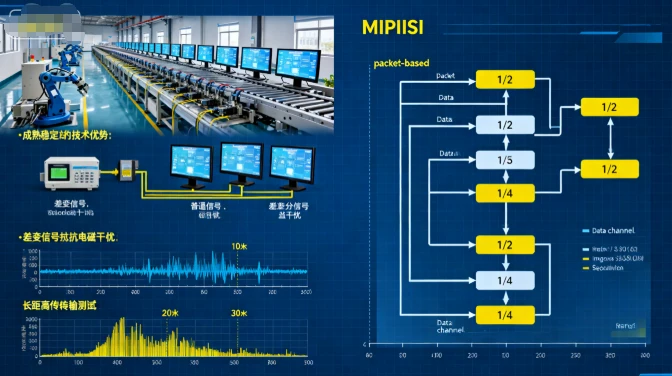
Noise Immunity: Differential signaling makes it highly resistant to electromagnetic interference (EMI), a critical factor for industrial settings.
Longer Cable Runs: Supports longer distances between the controller and the display compared to MIPI.
Considerations: It is a purely physical layer standard, meaning it only defines the electrical characteristics. The video data formatting must be handled separately.
MIPI DSI: The Modern, High-Efficiency Performer
MIPI DSI (Display Serial Interface) is a newer, packet-based protocol developed by the MIPI Alliance. It is the dominant standard in mobile devices and is increasingly popular in compact industrial designs.
Architecture: A more complex protocol that packets video data and commands into a serial stream. It can use 1, 2, or 4 data lanes.
Strengths:
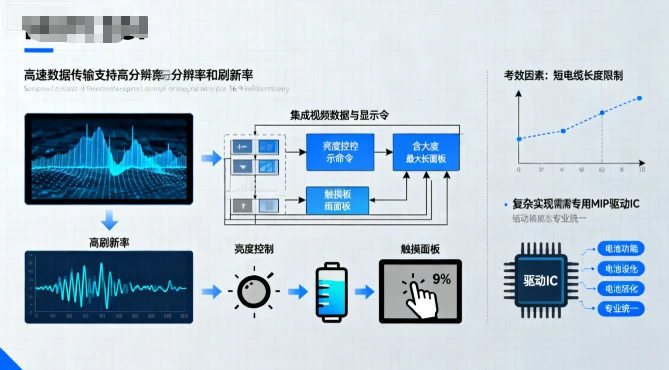
High Speed & Efficiency: Offers higher data throughput, supporting very high resolutions and refresh rates in a compact form.
Integrated Functionality: The protocol natively handles both video data and display commands (like brightness control or touch panel integration) over the same interface.
Lower Power Consumption: Designed for power efficiency, making it ideal for battery-operated or energy-conscious devices.
Considerations: The maximum cable length is shorter than LVDS. It is more complex to implement and may require specific MIPI-compatible driver ICs.
Comparison Table: MIPI vs. LVDS for Industrial Monitors
| Feature | LVDS | MIPI DSI |
|---|---|---|
| Full Name | Low-Voltage Differential Signaling | Display Serial Interface |
| Origin | Developed for general-purpose high-speed data transfer | Developed for mobile and embedded systems |
| Signal Type | Simple, continuous data streams | Packet-based, serial protocol |
| Noise Immunity | Excellent | Good, but more sensitive to signal integrity |
| Cable Length | Longer (several meters) | Shorter (typically < 30cm) |
| Power Consumption | Higher | Lower |
| Complexity | Lower (Physical Layer only) | Higher (Protocol + Physical Layer) |
| Ideal For | Large panels, long cable runs, high-EMI environments | Compact designs, high-resolution displays, low-power applications |
Choosing the Right Interface for Your Industrial Application
The choice between MIPI and LVDS ultimately depends on your specific requirements for an industrial touch screen monitor.
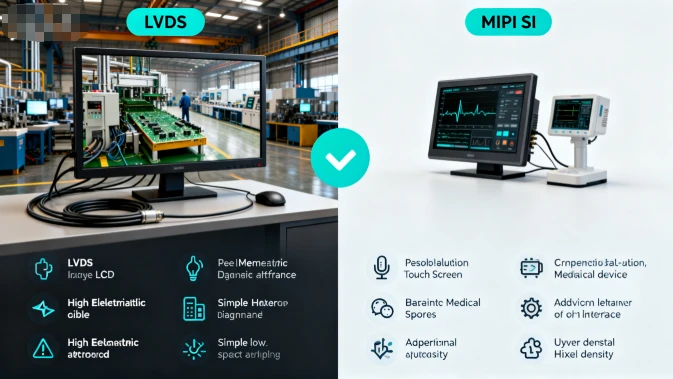
Choose LVDS if: Your project involves a large industrial LCD monitor that requires a long cable run, operates in a high-EMI environment (like a factory floor), or prioritizes design simplicity and proven ruggedness.
Choose MIPI DSI if: You are developing a compact, high-resolution touch screen monitor where power efficiency, space savings, and ultra-high pixel density are paramount, such as in portable medical diagnostic equipment or advanced human-machine interfaces (HMIs).
The Future is Flexible
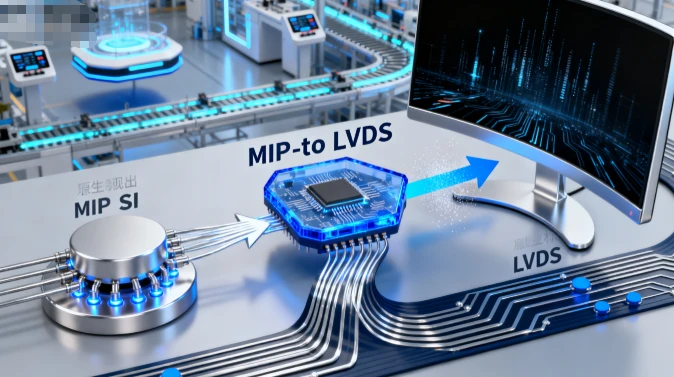
Many modern system-on-chips (SoCs) output a MIPI DSI signal natively. For applications that need the robustness of LVDS, a MIPI-to-LVDS bridge chip is a common and effective solution. This allows designers to leverage the efficiency of a modern processor while connecting to a robust, industry-standard LVDS display.
In summary, both technologies are vital for the industrial display ecosystem. LVDS remains the reliable, rugged choice for demanding environments, while MIPI DSI is the high-performance, efficient standard for the next generation of compact and powerful industrial touch monitors.