


What is Digital Signage?
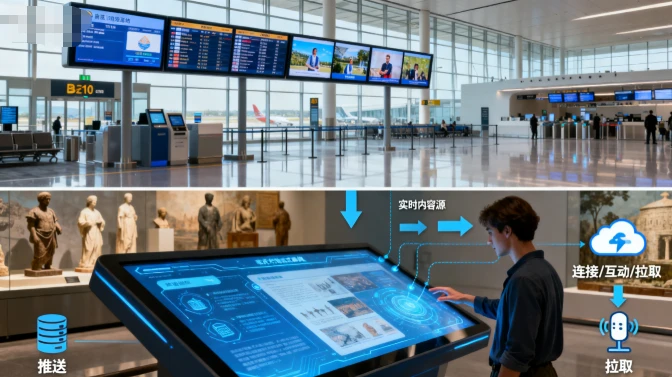
As digital signage increasingly impacts our lives and presents opportunities for the business world, its capabilities are also evolving from a passive system that pushes content to a more advanced system that connects, interacts, and pulls content from diverse sources in real-time.
Digital signage is a digital installation that displays video or multimedia content for informational or advertising purposes. We see it everywhere. We've gazed at advertisements at bus stations, found gate information at the airport, ordered food in fast food restaurants, bought movie tickets, and pulled up directions at museums, all thanks to digital signage. There are endless uses supporting a diversity of businesses and audience needs. As digital signage increasingly impacts our lives and presents opportunities for the business world, its capabilities are also evolving from a passive system that pushes content to a more advanced system that connects, interacts, and pulls content from diverse sources in real-time.
What is the definition of digital signage?
Let's try to get our heads around it. Wikipedia writes that "digital signage" is a subcategory of electronic signage, which, in turn, is defined as display technologies such as LCD, LED, projection, and e-paper. That's fairly unhelpful. Digital Signage is much more than just the hardware. Understanding today's digital signage requires consideration of its roles, functions, and technical capabilities.
What we can say is that digital signage is comprised of three key components:
Digital Signage Content
- An inventory of audio, video, image, graphics, text, and more, assembled to tell unique stories for any number of unique intents.
Digital Signage Hardware
– The physical, tangible components like screens, mounts, payment devices, printers, cameras, etc.
Digital Signage Software
– The digital infrastructure enabling the creation, deployment, management, and analysis of content deployed on the hardware
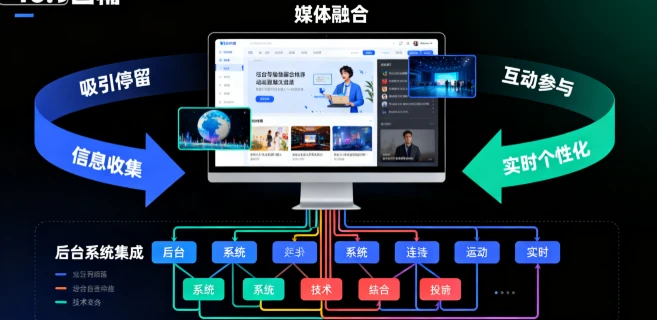
What is digital signage content? The simple notion of content is anything displayed on a screen, including text, images, animations, video, and audio. However, "content" can also refer to the collective result of combining various media to tell a story. Here it's about the overall experience imparted to the target audience. Dynamic digital content entices visitors or passers-by to stop, captures and engages them via interaction, and collects information for business insight. Such digital sign content can even be personalized in real-time through integrations with back-office systems.
Types of Digital Signage
There are various examples of digital signage that engage your guests. Here are some examples of the most common types of digital signage, based on usage scenario:
Public Signs
- location-specific information (news, weather, traffic, etc.), maps, wayfinding
01
Corporate Signage
- knowledge sharing, meeting room booking, meeting coordination, training
02
Sales Signage
- product/service portfolios, whiteboarding, demonstrations
03
Tourism & Wayfinding Signs
- wayfinding, points of interest, city information
04
Retail Signage
- self-check-out, endless aisle, product showcase, smart mirror
05
Restaurants Displays & Signs
- self-service, digital menu board, self-ordering kiosk
01
Marketing Signs, Motion Graphics & Ads
- promotions, ambiance, gamification
02
Museums Signage
- gallery, wayfinding, digital tours
03
Education based Signage
- classroom teaching, wayfinding, library exhibitions
04
Exhibit & Tradeshow Displays & Signs
- interactive product/service catalogs, visitor registration, networking
05
What is digital signage hardware?
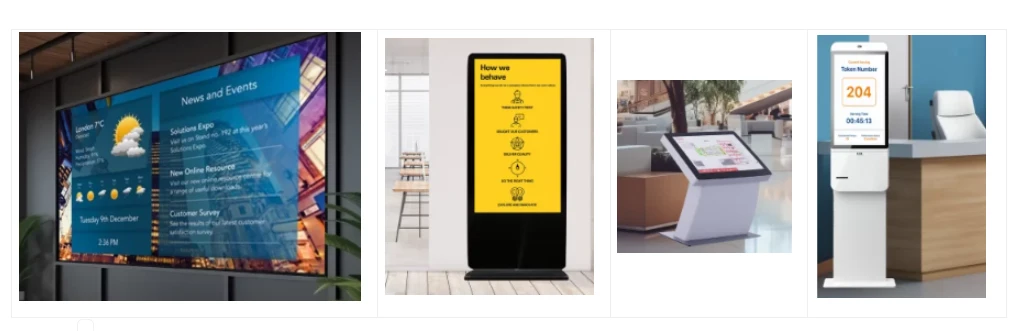
Digital signage hardware includes digital displays, digital media players, projectors, and audio systems.
Digital signage screens come in various sizes, resolutions, brightness, and support for interaction. Examples include LCD/LED flat panels, projection screens, touchscreens, and more. These display systems can be connected to digital media players, which contain the operating system and software applications used to run digital signage content. Some digital media players can be installed into the rear of a display or mounted externally on walls or stands with specialized brackets. Some displays are all-in-one, embedding the processor and supporting infrastructure, and do not need an external media player.
Conclusion
Digital signage is evolving rapidly. As the technology progresses, expect to see increased interactivity, connectivity with other systems, and the use of digital experiences as a sensor. All these benefits create more powerful opportunities for businesses to deliver unique experiences that engage customers while gathering valuable data points. This is what's ahead in digital signage software – an exciting time that promises breakthrough capabilities and insights into what consumers truly want.