


Let's first look at what kind of industrial computer products will use onboard CPUs. Onboard CPUs are directly fixed and integrated on the motherboard. Generally, fanless industrial computers will use this kind of motherboard with onboard CPU. Of course, fans can also be used. This kind of motherboard is also used in our lives. Mobile phones, tablets, and notebooks all use onboard CPUs. The purpose of doing this is to make the finished product as small as possible.
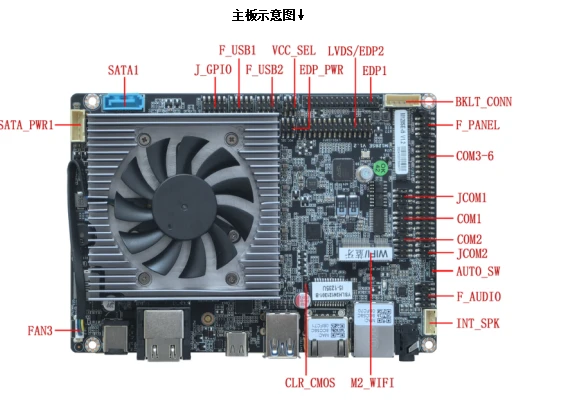
The application scenario of the industrial computer also determines the type of motherboard used. Most industrial computers use onboard CPUs to reduce the failure rate. Some projects have high requirements and even the memory and hard disk are directly integrated on the motherboard. The purpose is to reduce the product size and reduce failures. Small machines can be made into the size of a palm. The industrial scenarios used are generally small devices with the industrial computer embedded inside. The most common industrial computers with split CPUs are 4U industrial computers, which have large chassis and many accessories. They are not suitable for equipment that runs independently for a long time and are prone to problems.
The following is a model of an split CPU
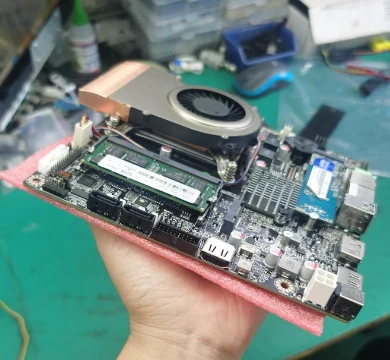
Comparing the failure rate of industrial computers, industrial computers with onboard CPUs have basically no components. The onboard CPU and onboard running memory, only the hard disk and expansion module can be replaced, and the power consumption of the whole machine is also low. The whole machine is highly sealed, dust-proof and vibration-resistant, and the probability of failure is very small.
Products with split CPUs, such as 4U industrial computers, are about the same size as our home hosts, and there are many choices of motherboards. There are market standard manufacturers with cheap production prices, unlike onboard ones, which are all special-shaped boards designed and produced by manufacturers themselves and are expensive. However, products with independent CPUs have many components, such as independent power supplies, motherboards, CPUs, memory, hard disks, system fans, etc. The more things there are, the easier it is to cause failures. The components with high failure rates are independent power supplies, system fans, hard disks, and motherboards. The chassis cannot be sealed, and it is easy to get dust and humid environments, which are not suitable for use.
In terms of performance, there is a difference between onboard industrial computers and split CPU industrial computers. Onboard CPU industrial computers use low-power processors. Under the same level of CPU, independent CPU industrial computers have advantages and much stronger performance. Therefore, many industries such as visual inspection give priority to 4U industrial computers, which are cheap and have strong performance. If you want to use fanless industrial computers in the visual industry, you need to use a more basic low-power version of the CPU, but the price will be much higher.
To summarize, when the space is small and needs to run for a long time 7*24 hours, choose onboard CPU, which has a low probability of failure. When used in large equipment and the operation time is not long, it is recommended to use a split cpu computer, which has strong expansion performance, strong performance and low price.