


The Core Difference Between LCD and OLED
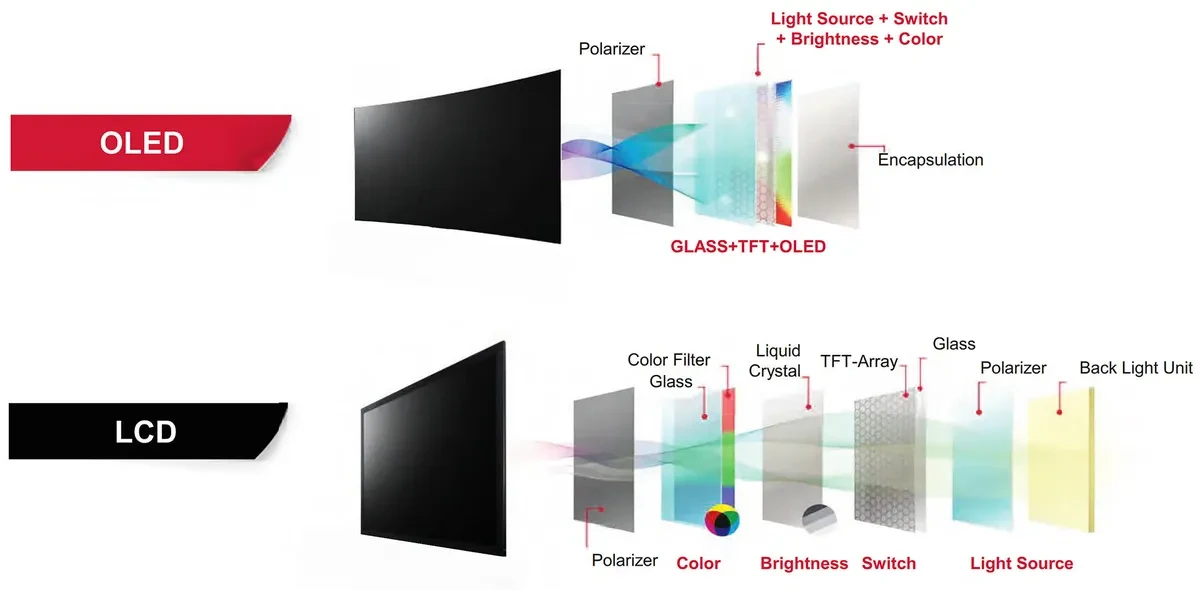
The fundamental difference lies in how they produce light and control pixels:
| Feature | LCD (Liquid Crystal Display) | OLED (Organic Light-Emitting Diode) |
|---|---|---|
| Light Source | Requires a backlight (usually LED). The entire screen is uniformly lit from behind. | Self-emissive pixels. Each individual pixel generates its own light. |
| Black Levels & Contrast | Good. Liquid crystals block the backlight, but some light always leaks through, resulting in "grayish" blacks and a lower contrast ratio. | Perfect. Pixels can turn off completely, achieving true black and an essentially infinite contrast ratio. |
| Viewing Angles | Very good on modern IPS-type panels, but color and contrast can still shift at extreme angles. | Excellent. Minimal color or brightness shift even at severe viewing angles. |
| Response Time | Good, but slower. Liquid crystals need time to twist and untwist, which can cause slight motion blur in fast-paced content. | Extremely fast. Virtually instantaneous pixel response, resulting in smoother motion and less blur. |
| Color Gamut | Can be very wide and accurate, especially on high-end models. | Typically excels, offering vibrant and saturated colors. |
| Power Consumption | Constant backlight consumption. Power usage depends more on the backlight brightness than the image content. | Content-dependent. Displays with lots of black pixels consume significantly less power. |
| Thickness & Flexibility | Thicker due to the backlight and multiple layers. Rigid by nature. | Thinner and lighter. Can be made flexible or even rollable. |
| Risk of Burn-in | Not susceptible. Image retention is temporary and rare. | Potential risk. Static elements displayed for very long periods can cause permanent "burn-in". |
| Cost | Generally less expensive for equivalent sizes, especially in larger formats. | Typically more expensive, though costs are decreasing. |
In essence: LCD is a light valve technology that blocks a constant backlight, while OLED is a light creation technology where each pixel is a microscopic light bulb.
When is Full Lamination Required for the Cover Glass?
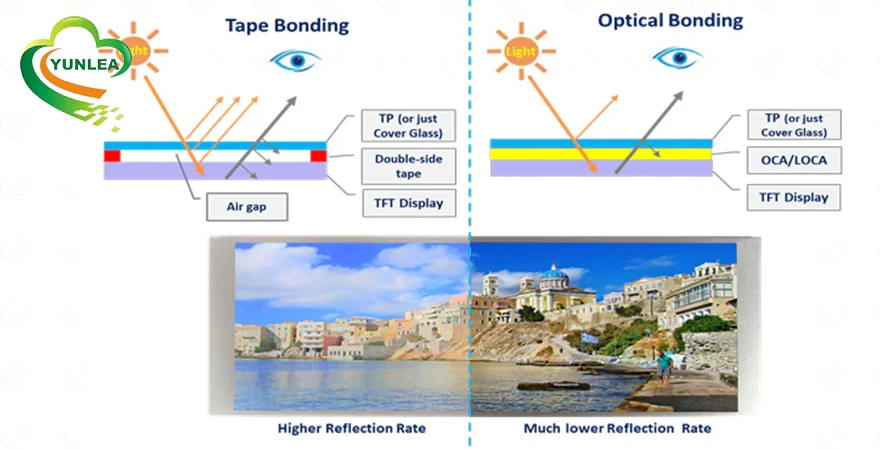
Full Lamination is the process of optically bonding the cover glass directly to the LCD (or OLED) panel using a clear optical adhesive (OCA), eliminating the air gap between them.
It is critically required in the following scenarios:
1. High-Brightness & Outdoor Use (Sunlight Readability)
Why: Every air-to-glass interface (between the layers) causes internal reflections. In bright environments, these reflections drastically reduce contrast and make the screen unreadable.
Benefit: Full lamination reduces reflections by over 60%. This, combined with a high-brightness panel (≥1000 nits) and an Anti-Reflective (AR) coating, is essential for sunlight readability in applications like:
Outdoor kiosks and POS systems
Marine and aviation displays
Industrial HMI panels in brightly lit factories
2. Enhanced Durability and Sealing
Why: The adhesive layer adds structural integrity.
Benefit:
Reduces Dust and Condensation: Eliminating the air gap prevents dust from getting trapped between the layers and stops internal fogging due to temperature/humidity changes. This is crucial for medical devices (which require frequent sterilization) and dusty industrial or food processing environments.
Improves Impact Resistance: The bonded structure better distributes shock from an impact, making the display more robust and less likely to delaminate.
3. Superior Optical Clarity and Touch Experience
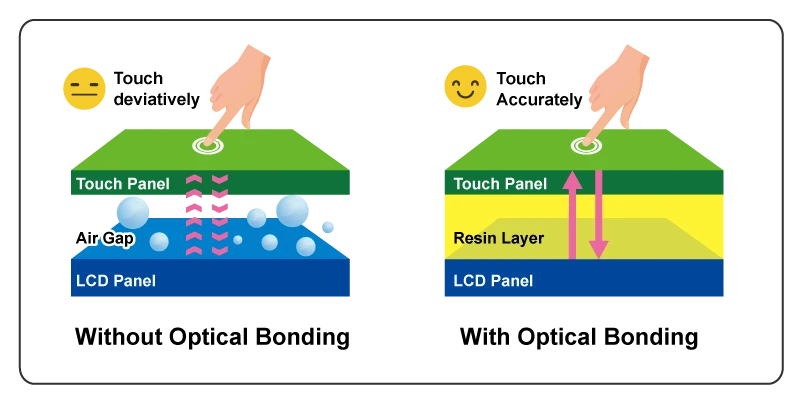
Why: The air gap causes a slight "parallax effect," where the image appears to be beneath the surface, and can make touchscreens feel less precise, especially with a stylus.
Benefit: The image appears sharper and closer to the surface. Touch interaction feels more direct and accurate. This is vital for:
High-end interactive digital signage
Devices used with a stylus (e.g., advanced POS systems, design kiosks)
Any application where visual fidelity and precise touch are paramount.
4. Industrial and Public Environments
Why: Vandalism and moisture are constant threats.
Benefit: When combined with a thick, chemically strengthened glass (e.g., DragonTrail, Gorilla Glass), full lamination creates a solid, monolithic front surface that is extremely difficult to pry apart and is highly resistant to scratches and impacts. This is used in:
Public transportation ticket machines
Gaming and lottery terminals
Self-service check-in kiosks
Summary: You should specify full lamination when the display will be used in high-ambient-light conditions, harsh environments (dust, moisture, vibration), or where superior optical performance and durability are critical requirements.