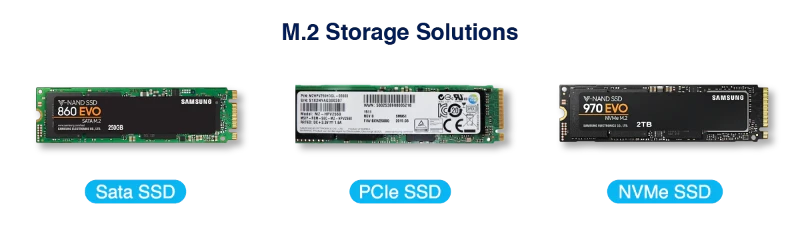
The main interface types for computer hard drives include SATA, mSATA, M.2, PCI-E, and U.2. Each interface type has its own specific application scenarios and performance characteristics:
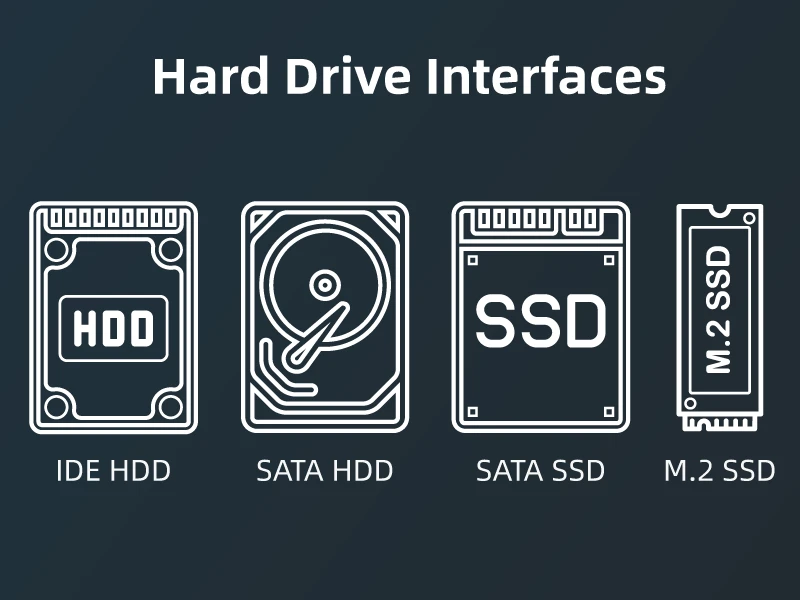
SATA : This is the most common hard drive interface type, suitable for the home market. The bandwidth of the SATA interface is 6Gbps, which is suitable for ordinary 2.5-inch SSDs and older HDDs. It is mature technology, but the bandwidth may not be enough for the new generation of SSDs.
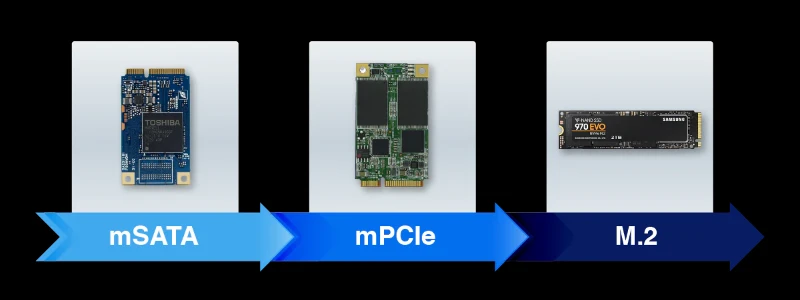
mSATA : This is a mini version of the standard SATA interface, suitable for small devices such as small notebooks and business notebooks. Although limited by the SATA channel, it is small and easy to install.
M.2 : Designed specifically for ultrabooks, it is small in size and supports the NVMe standard, which can significantly improve SSD performance. The M.2 interface supports multiple protocols, including SATA and NVMe, and is suitable for ultrabooks and desktops.
PCI-E : The SSD of this interface is extremely fast and directly connects to the PCI-E bus of the motherboard, eliminating the intermediate process from SATA to PCI-E. It is mainly used for high-end SSD products, but the cost is high and the requirements for the motherboard are high.
U.2 : Suitable for enterprise-level applications, with a faster transmission speed of up to 32Gbps. It is mainly used in servers and high-performance storage systems.
For the selection of industrial computers, the following factors usually need to be considered: Stability: Industrial computers usually need to operate stably in harsh environments, so it is more appropriate to choose a hard disk interface with strong shock resistance and not easily affected by external interference. NVMe SSD and M.2 interface SSD have strong shock resistance due to the lack of mechanical parts, which is suitable for industrial applications.
Performance requirements: Industrial applications often require high-speed data processing capabilities. NVMe SSD provides extremely high read and write speeds through the PCI-E interface, which is suitable for industrial scenarios that need to process big data and high-load tasks.
Compatibility and scalability: Choose an interface that supports the latest technologies and protocols to ensure future scalability and compatibility. The M.2 interface supports multiple protocols and has good flexibility.
Here are the common hard drive interfaces and recommendations for industrial computers:
Common Hard Drive Interfaces:
SATA (Serial ATA):
Description: The standard interface for consumer HDDs and SSDs.
Versions: SATA I (1.5 Gbps), SATA II (3 Gbps), SATA III (6 Gbps).
Form Factors: 2.5-inch, 3.5-inch (HDDs), 2.5-inch (SSDs), M.2 SATA (using SATA protocol).
SAS (Serial Attached SCSI):
Description: Enterprise/professional interface, backward compatible with SATA. Offers higher speed, reliability, dual-porting, and better error handling.
Versions: SAS-1 (3 Gbps), SAS-2 (6 Gbps), SAS-3 (12 Gbps), SAS-4 (24 Gbps).
Form Factors: 2.5-inch, 3.5-inch (less common now).
NVMe (Non-Volatile Memory Express) over PCIe (Peripheral Component Interconnect Express):
Description: High-performance protocol designed specifically for fast flash storage (SSDs), bypassing legacy SATA/AHCI bottlenecks. Connects directly via PCIe lanes.
Form Factors: M.2 (most common), U.2 (2.5-inch), Add-in Card (AIC), EDSFF variants.
M.2 (Form Factor & Interface):
Description: A compact slot that supports both SATA (using AHCI protocol) and NVMe (using PCIe protocol) SSDs. Keying (B-key, M-key, B+M key) indicates supported protocols.
USB (Universal Serial Bus) - External Only:
Description: Common for external drives (HDDs, SSDs). Versions include USB 3.2 Gen 1 (5 Gbps), Gen 2 (10 Gbps), Gen 2x2 (20 Gbps), USB4 (20/40 Gbps).
(Legacy) IDE/PATA (Parallel ATA):
Description: Obsolete interface, rarely found in modern systems. Used ribbon cables.
Recommendations for Industrial Computers:
For industrial PCs (IPCs), prioritize reliability, durability, tolerance to harsh environments (temperature, shock, vibration), and long-term availability over raw peak performance. Here's the recommendation:
Industrial-Grade SATA SSDs (2.5-inch or M.2 SATA):
Why:
Wide Compatibility: Universally supported by industrial motherboards and controllers.
Robustness: Available in industrial variants rated for extended temperature ranges (e.g., -40°C to +85°C), higher shock/vibration tolerance, and power-loss protection (PLP).
Reliability: Use higher-grade NAND flash and controllers designed for 24/7 operation and longer endurance (Total Bytes Written - TBW).
Cost-Effectiveness: Generally more affordable than industrial NVMe or SAS drives while offering significantly better performance and reliability than HDDs.
No Moving Parts: Critical for vibration-prone environments.
Ideal For: Most industrial applications (automation, HMI, kiosks, medical devices, transportation, embedded systems) where consistent performance and reliability under harsh conditions are paramount, and SATA speeds are sufficient.
Industrial-Grade NVMe SSDs (M.2 or U.2):
Why:
Performance: Essential for applications needing very high throughput and low latency (e.g., machine vision, high-speed data logging, edge AI).
Industrial Variants: Also available with extended temp, shock/vib specs, PLP, and high endurance.
Considerations:
Ensure the IPC motherboard has M.2 slots supporting NVMe (PCIe lanes).
NVMe drives can generate more heat; verify thermal management in the enclosure.
Higher cost than SATA SSDs.
Ideal For: High-performance industrial tasks where SATA bandwidth is a bottleneck.
Industrial HDDs (SATA or SAS - Only if SSD isn't feasible):
Why (Limited Cases):
Extremely High Capacity Needs: If requiring 10TB+ per drive at a lower cost-per-GB than SSD (though large SSDs are becoming more affordable).
Sequential Workloads: Some surveillance DVR/NVR applications.
Significant Drawbacks:
Mechanical Failure Points: Highly sensitive to shock, vibration, and temperature extremes.
Lower Reliability & Lifespan: Generally less reliable than SSDs in demanding environments.
Slower Performance: Especially for random access.
Power Consumption: Higher than SSDs.
Use with Caution: Only consider industrial/video-grade HDDs specifically rated for 24/7 operation and moderate vibration if SSD capacity/cost is truly prohibitive. SSD is strongly preferred.
Key Selection Factors for Industrial PCs:
Environment: Temperature range, shock/vibration levels, dust/moisture.
Duty Cycle: 24/7 operation requires higher endurance.
Performance Needs: Sequential vs. random read/write speeds, IOPS.
Capacity Requirements.
Power Constraints: SSDs consume less power than HDDs. NVMe can be higher than SATA SSD under load.
Shock/Vibration Tolerance: SSDs win decisively.
Data Integrity: Power-loss protection (PLP) is highly recommended.
Longevity & Supply: Industrial suppliers offer long-term availability guarantees.
Interface Support: Match the drive to the available ports on the IPC motherboard/controller.
In summary, for the vast majority of industrial computer applications,
an Industrial-Grade SATA SSD (2.5-inch or M.2) is the optimal choice due to its excellent balance of reliability, durability,
wide compatibility, performance, and cost-effectiveness in harsh environments.
Use Industrial NVMe SSDs for high-performance needs, and avoid HDDs unless absolutely necessary for massive,
cost-sensitive sequential storage where environmental factors are tightly controlled.